LEER EN CASTELLANO ︎︎︎
SPEC SHEET BELOW ︎︎︎
A Place With No Shelter
A Place With No Shelter
MADRID — 2014 / 16
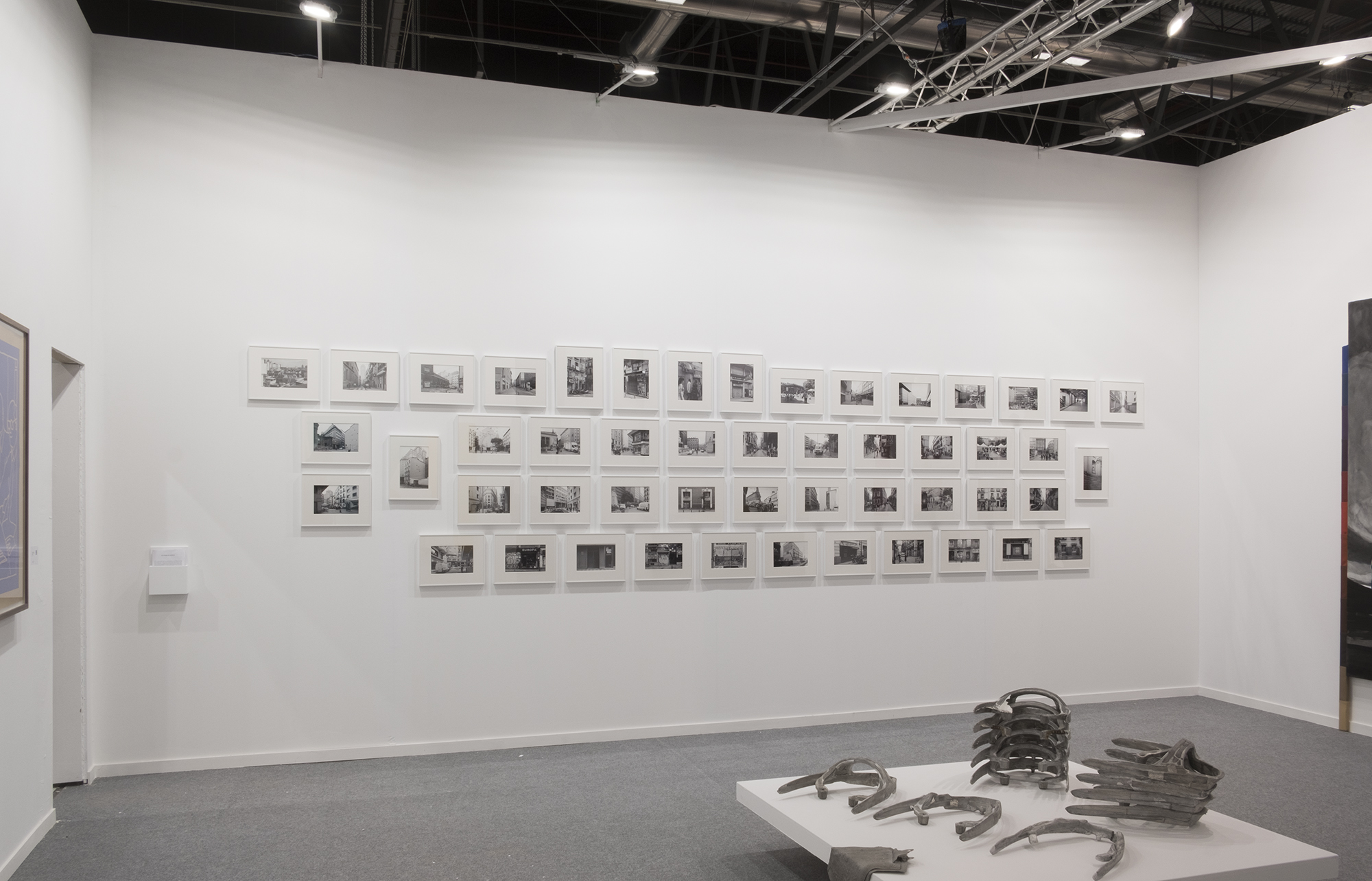
In A Place With No Shelter, a series made up of fifty photographs taken between 2014 and 16, Alejandro S. Garrido looks at the regeneration process that Madrid Downtown has suffered in the last decade. The photographer reviews the tensions created by the urban development model and the limits that it imposes on the daily experience of the city. Garrido takes Gran Vía, one of the largest streets in Madrid, and its area of influence as his framework, to delve into its updating as a strategic investment location. The series is organized as a journey through the neighborhoods of Chueca, Universidad (also known as “Malasaña”) and Sol, taking into account problems such as gentrification, touristification, loss of heritage or social and commercial homogenization.
For the author, historic centers are those places where the identity of a city is formed in the collective imagination. They define the sense of belonging within the urban community. However, thrown by their rulers into the jaws of the real estate market and the tourism industry, they are devoured by a dynamic of expulsion in which their significance irremediably vanishes. Without history or neighbors, given over to naked consumption, the city as the scene of life is reduced to a mere carcass.
For the author, historic centers are those places where the identity of a city is formed in the collective imagination. They define the sense of belonging within the urban community. However, thrown by their rulers into the jaws of the real estate market and the tourism industry, they are devoured by a dynamic of expulsion in which their significance irremediably vanishes. Without history or neighbors, given over to naked consumption, the city as the scene of life is reduced to a mere carcass.
 Rear view of the southeastern side of Gran Vía from a rooftop in Plaza de Callao.
Overview of Neoliberal Reappropriation in Central Madrid
On 1 January 1995, following the liberalisation process set in motion by the 1984 “Boyer Decree,” a new Urban Leases Act (Ley de Arrendamientos Urbanos, or LAU) came into force. The legislation paved the way for the gradual phasing out of long-standing rent-controlled leases by significantly restricting the transfer of tenancy rights to family members and establishing a ten-year period for their adjustment. Until then, the low profitability of rental housing had discouraged the maintenance of properties in Madrid’s historic centre. Years of insufficient investment had left the city’s oldest neighbourhoods in an unsustainable state of social and architectural decline. The new LAU facilitated the area’s revaluation, enabling property owners who succeeded in obtaining an official declaration that their buildings were structurally unsafe to evict their tenants while, in some cases, gaining access to subsidies for housing rehabilitation. Although strong expectations of economic growth attracted investment, they also fuelled a climate of speculative fever in which practices such as hoarding vacant properties, deliberately allowing buildings to deteriorate, deception, and bribing tenants to leave their homes became commonplace. Ultimately, this included resorting to asustaviejas—thugs who used verbal and physical intimidation against tenants who refused to terminate their leases. Almost overnight, rents for commercial premises and housing in central Madrid increased fivefold, undermining the viability of small and medium-sized businesses and driving a gradual demographic replacement that would become firmly established over the following decade.
When the ten-year period established by the LAU for adjusting long-standing rent-controlled leases came to an end in 2004, Madrid City Council and the regional government embarked on an urban regeneration process aimed at transforming the city centre into an internationally recognised brand. Between 2006 and 2011, public authorities created favourable conditions for the arrival of major retail brands and franchises, liberalised retail opening hours and sales periods, and pedestrianised streets and squares along the main commercial thoroughfares, such as the Fuencarral-Montera-Arenal and Preciados-Carretas axes. Following a model of “public-private partnership,” the conversion of traditional food markets into gastronomic hubs also became a central element of the new urban planning strategy. Increasingly geared towards occasional visitors, these markets largely lost their role as organising centres of the social fabric. San Antón, San Miguel and Barceló were all clear examples of this trend, albeit with varying degrees of success. Finally, with the aim of displacing “undesirable” activities such as street prostitution, drug use and botellón (public drinking in squares and other public spaces), the authorities implemented a strategy of pacification and cleansing. This involved combining sensationalist media coverage of these activities on regional television with the installation of street surveillance cameras and the opening of two Municipal Police stations, on Calle Montera and in Plaza de Santa María Soledad Torres Acosta, two locations regarded as particularly problematic.
In 2007, on the orders of Mayor Alberto Ruiz-Gallardón, the police blocked access to Plaza del Dos de Mayo in an attempt to prevent the neighbourhood of Universidad from holding its traditional street festival for the fourth consecutive year. Since 2002, the “anti-botellón law” had been enforced with extreme severity, creating a climate of mounting tension that erupted that night into a revolt involving hundreds of young people. The violent police crackdown left seventy people injured and twenty arrested and, after two nights of clashes, marked the end of botellón in Malasaña. The cleared squares, however, were soon filled with terraces licensed by the City Council. A year after the riot, under the slogan “Creative Squatting,” the TriBall (Triángulo Ballesta) property consortium made the forty-five commercial premises it had accumulated available to fashion designers and multidisciplinary artists. The projects they submitted, a TriBall representative claimed, were “in keeping with a philosophy of an authentic and cosmopolitan neighbourhood.” The initiative, whose stated aim was to increase the value of the area, received the open and unconditional support of public institutions. The strategy worked, and within a few years average rents in Malasaña and Chueca had risen by 30%. However, the burgeoning creative class that had settled in the area saw its future threatened when the bursting of the property bubble opened up a new window of opportunity for international investment and the tourism industry.
Amid a deepening crisis, with families being evicted every day and left without any housing alternative, stagnant prices and a glut of available properties placed Gran Vía and its surrounding area firmly in the sights of major investors. The buying and selling of landmark buildings and large portfolios of housing surged. The emerging property cycle was fuelled both by the development of new investment vehicles, such as SOCIMIs (Listed Real Estate Investment Companies), and by the 2013 Law on the Promotion of Rental Housing, an amendment to the LAU that further deregulated the rental market by decoupling rent increases from the Consumer Price Index (CPI). The measure allowed rents in the district to rise by 15% within a matter of months. The immediate consequence was the displacement of tenants and the uncontrolled growth in the number of properties being converted to tourist accommodation. The processes of touristification and gentrification in the historic centre were further intensified by the systematic conversion of buildings into flagship stores for major retail companies, prime office space, hotels and luxury apartments.
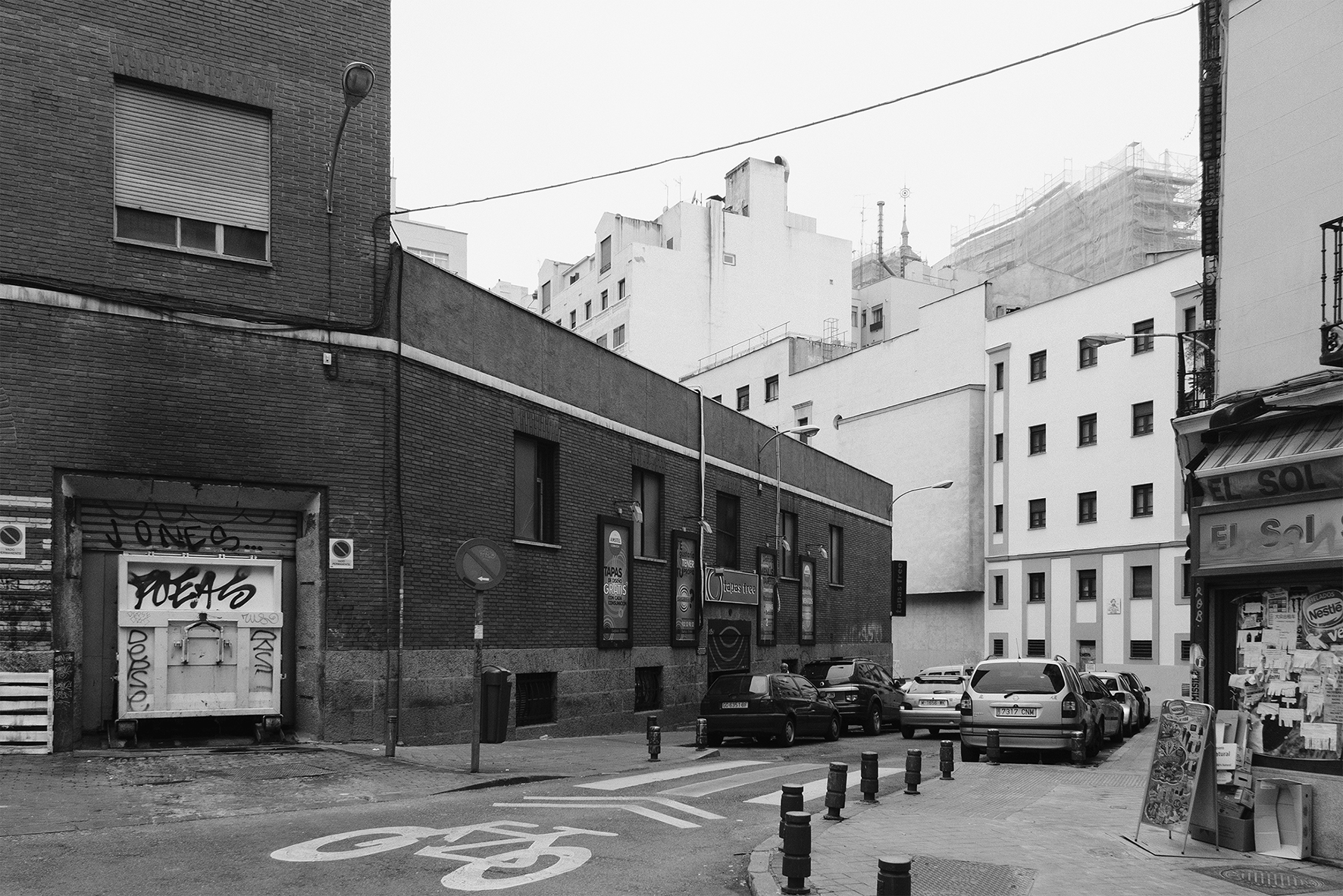
In 2014, in response to this context and taking Gran Vía as the project’s organising axis, I set out to photograph the situation in central Madrid for two reasons. The first was my biographical and emotional connection to the subject and the area. For years, I had witnessed the changes taking place in a part of the city that I visited almost daily and to which I felt deeply attached. The second reason was proximity—a mere practical condition that made the project possible, since at the time I worked in a nearby tavern and had only a couple of hours each day, between the end of the lunch shift and the beginning of the dinner shift, in which to take the photographs. The premise of the project was to focus on the renewed positioning of Gran Vía as a strategic axis for investment, seeking to examine the tensions generated by the prevailing model of spatial production and the limits it imposes on the urban experience. I also chose to work under the constraint of avoiding the avenue itself. Instead, I preferred to focus on its backstreets and surrounding neighbourhoods—places that, although removed from its monumental character, were nonetheless inevitably shaped by its presence and influence.
Gran Vía was built from 1910 onwards as a prestigious urban space within a city that was socially and spatially divided. To a large extent, it was the outcome of the speculative accumulation cycle set in motion by the 1842 Tenancy Act (Ley de Inquilinato). The surplus generated by this accumulation subsequently enabled the development of the bourgeois extensions of the city between 1860 and 1930. The law liberalised urban rents at a time when demand was rising as a result of a significant influx of migrants. With the city suffering from an insufficient and unhealthy housing stock, Madrid’s rentier bourgeoisie, largely indifferent to industrial enterprise, used the legislation to extract greater returns from their assets. As an urban device, Gran Vía served to align Madrid with the capitalist development model emerging internationally during the Second Industrial Revolution. In a context of dependence on foreign capital and technology, a competitive showcase was crucial for attracting investors seeking opportunities for expansion. So much so that its final section, whose construction resumed during the final years of the autarky period, featured the tallest skyscrapers in Europe. At a time of political isolation and national bankruptcy, these buildings embodied a prosperity longed for by a destitute Madrid—a mirage of modernity more than the outcome of genuine national development.
The valorisation of historic city centres at the expense of certain peripheral areas has, in the case of many Western capitals, been driven by a narrative that categorises urban spaces as successful or failed according to purely business-oriented criteria. Although this process has fuelled the renewal of significant sections of the city, the new homogeneous configuration of city centres as tourist showcases entails substantial losses of social, commercial and heritage fabric. Historic city centres are the places where a city’s identity takes shape in the popular imagination; they are where a sense of belonging within the urban community is forged. For this reason, an inclusive city centre can play a decisive role in fostering social cohesion and a healthy public sphere. In contrast to the periphery as a blurred space in which the very conditions of habitability begin to unravel, an accessible city centre can help consolidate a sense of an integrated community. An exclusive and privileged centre, by contrast, produces the opposite sense of rootlessness and inferiority among those left on the margins. Faced with the fragmentation of the periphery, the loss of meaning of the city centre and growing urban dualisation, it is necessary to construct a new imaginary capable of making sense of this fragmented landscape and understanding the city for what it actually is: a constellation of hybrid, interdependent spaces.

Edificio España seen from Plaza de los Mostenses.

Edificio España (architects Julián and Joaquín Otamendi, 1953), seen from Calle de los Reyes. An icon of post-war Francoist triumphalism and a major business centre until the 1990s. In 2005, Santander Real Estate bought the building from Metrovacesa with the aim of refurbishing it. A decade later, having made no progress on the project, it sold the property to Wanda Group. The preservation of the façade became a point of contention between Manuela Carmena’s city government and the Chinese company, which subsequently divested itself of the property. Baraka Investment Group acquired it in 2016, and Corpfin Capital Real Estate and the Riu Hotels & Resorts chain eventually took over its redevelopment. It now houses the Hotel Riu Plaza and a shopping arcade on the ground floor.
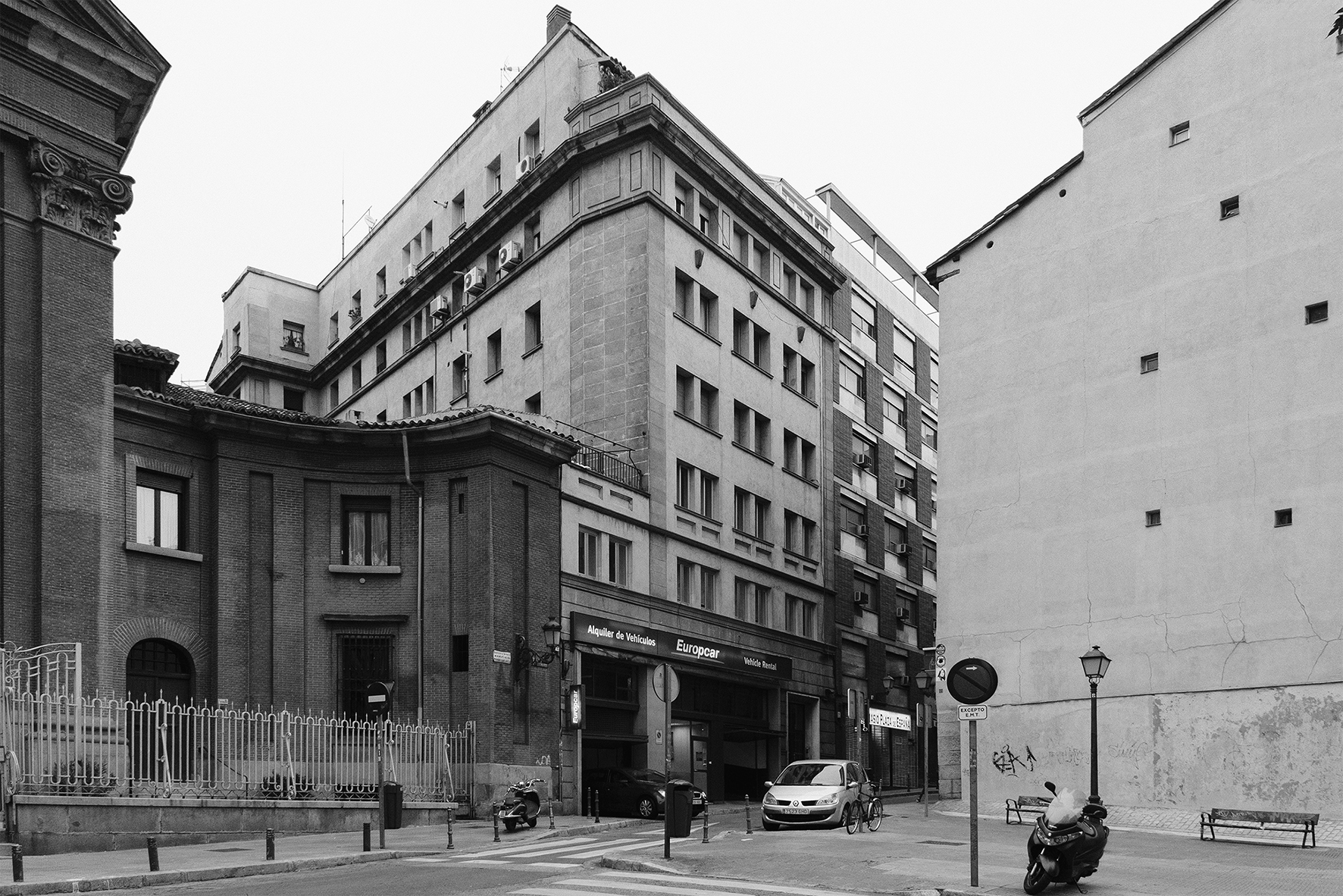
Intersection of Calle del Maestro Guerrero and Calle de San Leonardo. In the shadow of Edificio España, the backstreets still reveal the awkwardly configured plots left behind by the demolition of several blocks during its construction. The image shows the Church of San Marcos (architect Ventura Rodríguez, 1753).
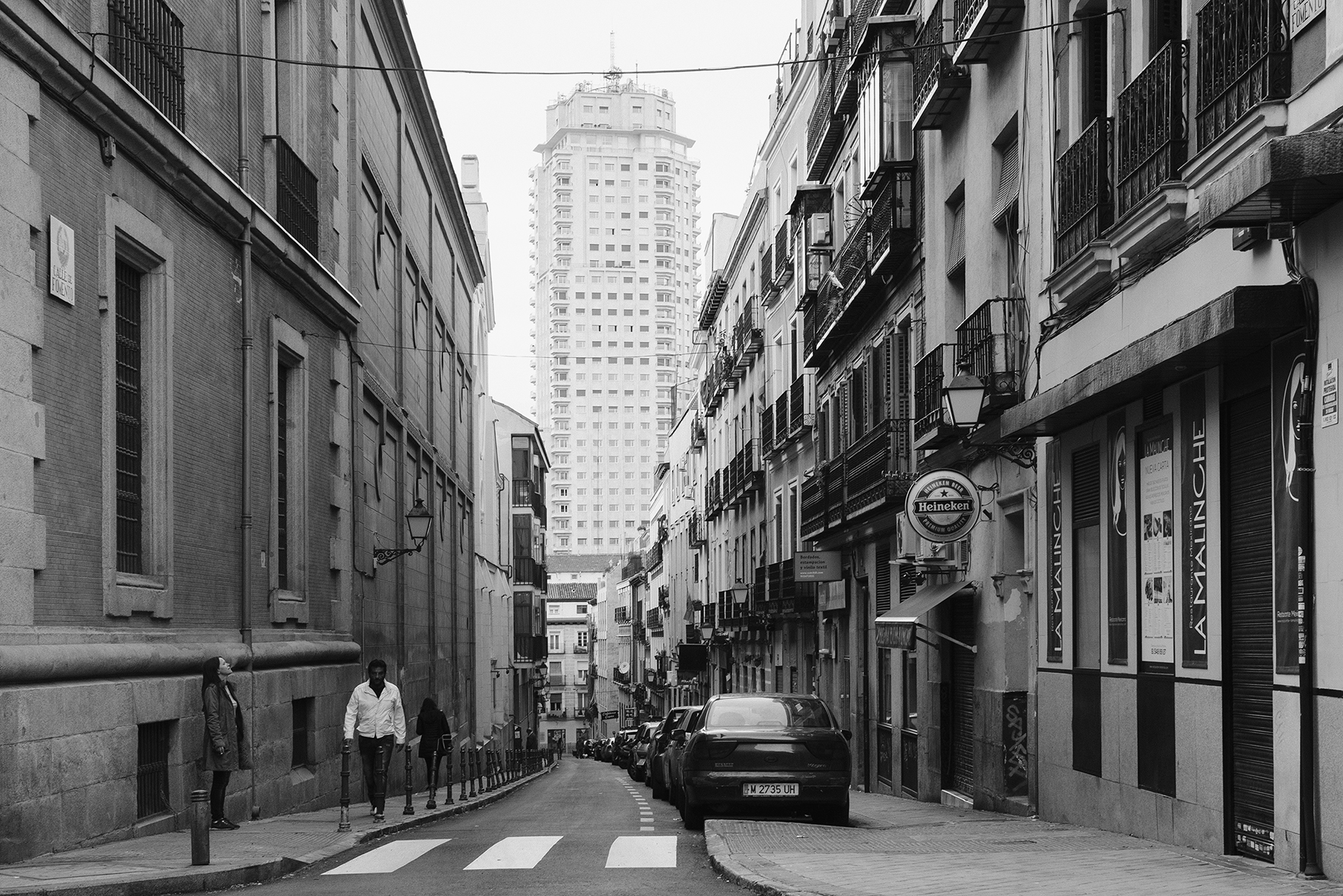 Torre de Madrid (architects Julián and Joaquín Otamendi, 1960), seen from Calle de Fomento. A symbol of Spain’s emerging developmentalism, the tower was inaugurated one year after the 1959 National Economic Stabilisation Plan, which liberalised the Spanish market and brought an end to the autarkic period. Owned by Metrovacesa / Merlín Properties SOCIMI S.A., it was refurbished in 2012 and is now a mixed-use building comprising a hotel and luxury residential units.

Plaza de los Cubos shopping centre on Calle de la Princesa. The complex, comprising Torre de Madrid, three office buildings and twenty-one commercial premises, is owned by Merlin Properties S.A., which, after acquiring Testa (Sacyr’s property arm) in 2015, became the first SOCIMI to be included in the IBEX-35. That same year, real estate investment exceeded the figures recorded in 2007, reaching €13 billion. SOCIMIs accounted for 45% of sector activity at the time, with 70% of their capital coming from investment funds based in Canada, the United Kingdom and France. By 2020, the combined market capitalisation of these companies had reached €27 billion (2% of GDP). Although Spain has more SOCIMIs than any other European country (90), 64% of their market capitalisation—and a similar proportion of their assets—is controlled by the five largest companies.

Passageway in Plaza de los Cubos, on Calle de la Princesa.
 The building in Plaza del Carmen, successively known as the Frontón Central, Gran Kurssal, Teatro Madrid and Cine Madrid (architects Daniel Zavala and Luis Esteve, 1898). The developer demolished the building’s central hall and metal structure without a building permit, while the project was still undergoing public consultation. Although these elements were not formally protected, the Madrid Ciudadanía y Patrimonio Platform had called for their preservation when they were demolished. Formerly owned by Grupo SADE. Now a MediaMarkt store.

Muro de la Paz in Plaza del Carmen. The mural was painted in 1982 to mark the UN-sponsored Disarmament Week. It bears the inscription, signed by Mayor Enrique Tierno Galván: “Peace does not come without effort. If you want peace, work for peace.

Designated High Tourist Influx Area. Calle de Preciados at the intersection with Calle de Maestro Victoria.

Plaza de Callao. Pedestrianised in 2010, the square is frequently used for temporary commercial installations. Its design, devoid of street furniture and green spaces, effectively leaves pedestrian traffic and consumption as its only intended uses. The image shows the former Galerías Preciados building (architect Luis Gutiérrez Soto, 1943), home to Fnac since 1993 and Spain’s first major department store. It is now owned by Metrovacesa / Merlin Properties SOCIMI S.A.

Detail of the façade of Edificio Capital Gran Vía 48 on Calle de Tudescos (architect Rafael de La-Hoz Castanys, 2013). Owned by Valmarcasa S.L. and GLL Real Estate Partners GmbH.

Vacant premises on Calle de Carretas.
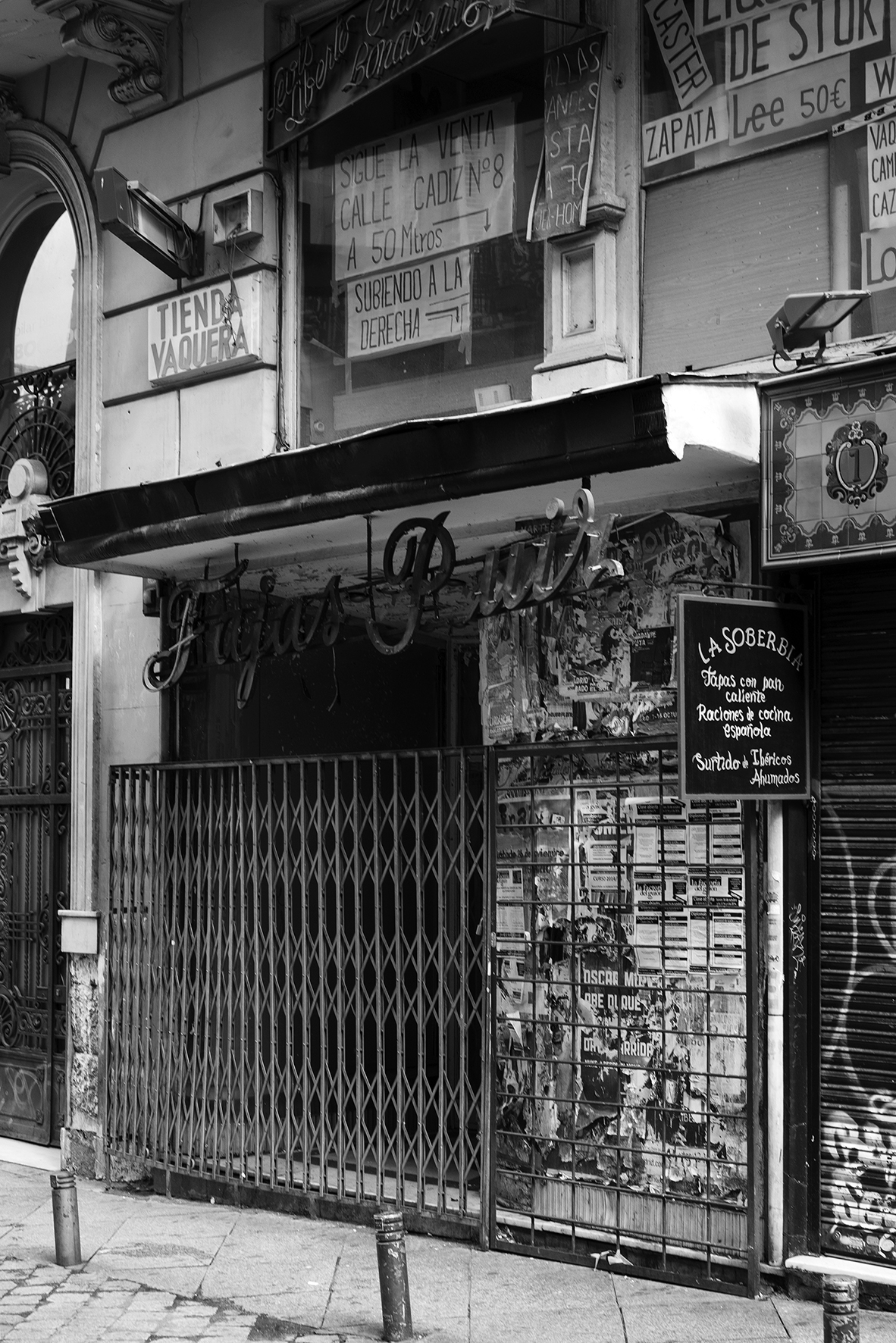
Former clothing shops on Calle de Carretas.

Detail of the façade of the Palacio de la Música on Calle de la Abada (architect Secundino Zuazo, 1926). Owned by Fundación Montemadrid. Awaiting refurbishment after fourteen years of disuse.
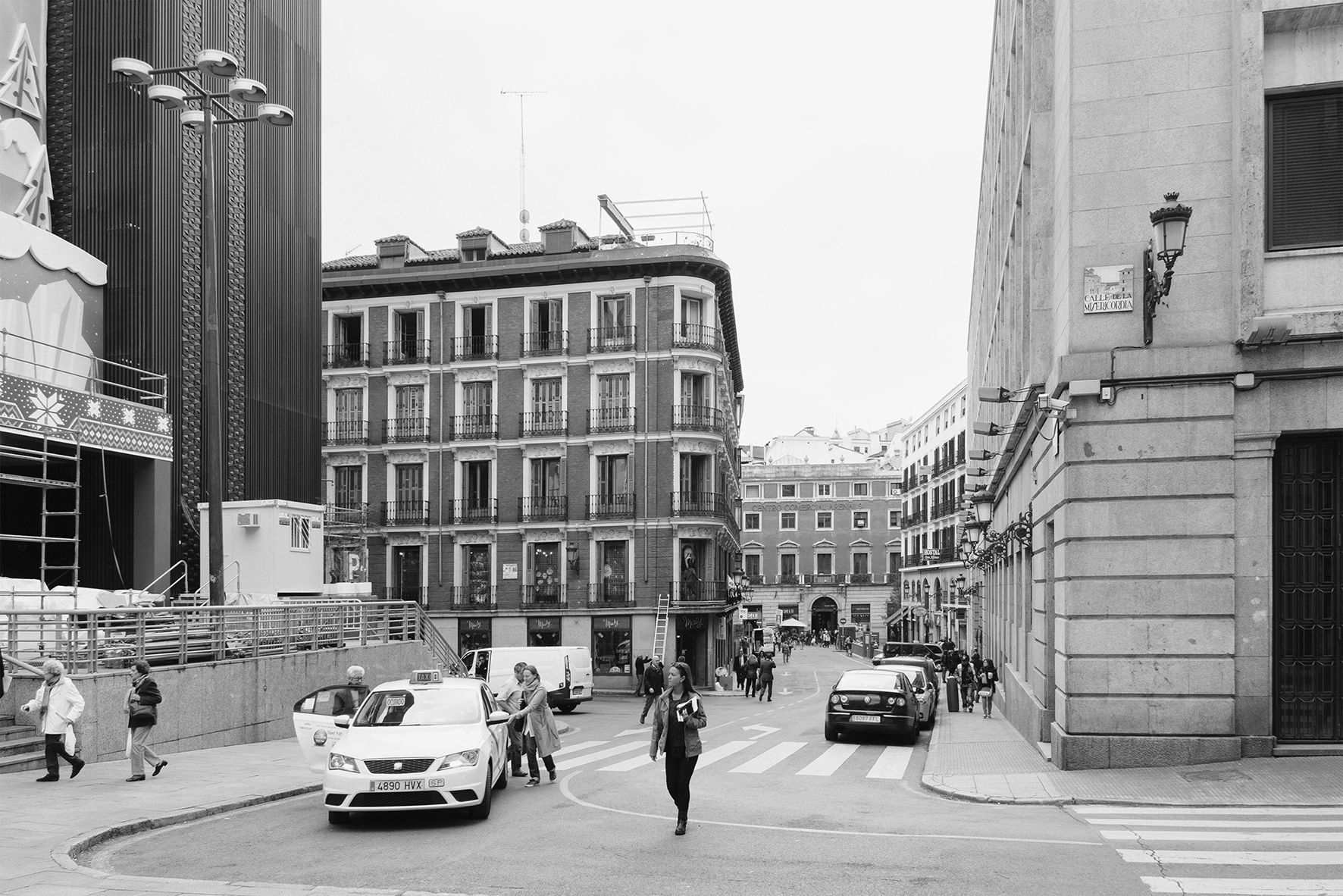 Former headquarters of the Caja de Ahorros y Monte de Piedad (Caja Madrid, Bankia, Fundación Montemadrid), on Calle de San Martín at the intersection with Calle de la Beneficencia. The building is currently being converted into a luxury hotel by KKH Property Investors and Perella Weinberg Partners, its new owners.

Pubs, guesthouses and a jewellery shop on Calle de Espoz y Mina.

Hotel Madrid on Calle de Carretas. After twenty years of abandonment, the hotel was occupied by activists in the days following 15 May 2011 and made available to families evicted from their homes following mortgage foreclosures. It was evicted in December of the same year following a complaint by Grupo Monteverde, then the owner of the property. The building has since been refurbished as a luxury hotel and nightclub alongside the former Teatro Albéniz (closed in 2008). The property is owned by Silicius, a SOCIMI belonging to the Mazabi financial group, and is currently awaiting a new operator after the hotel chain Iberostar recently withdrew from the project due to the pandemic.

View of Plaza Mayor. Property development advertisement displayed in a vacant commercial premises on Calle del Dr. Cortezo.
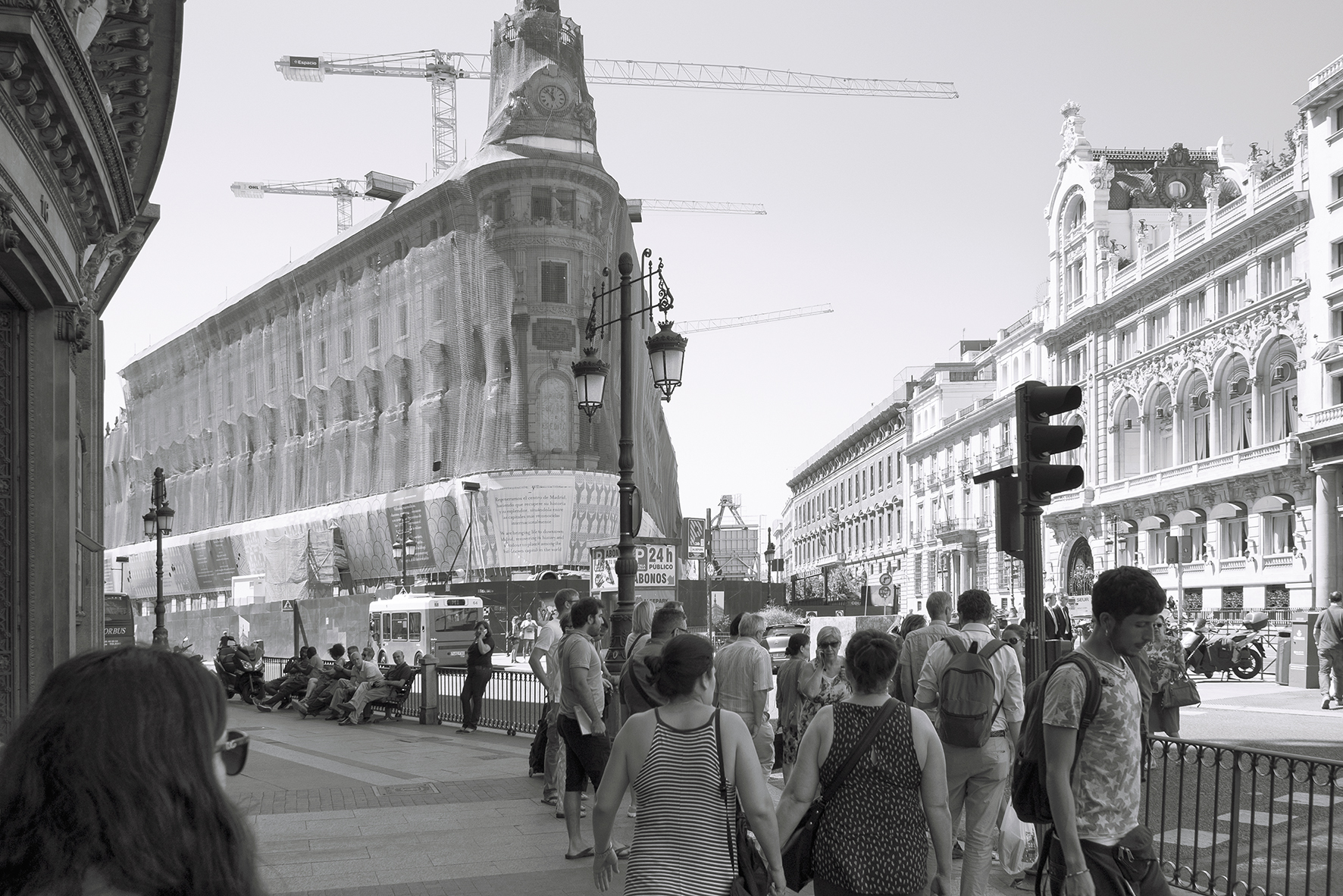
Redevelopment of the Palacio de la Equitativa on Calle de Alcalá. The new Centro Canalejas, comprising a complex of seven historic buildings acquired by OHL in 2012, includes a luxury hotel operated by Four Seasons, twenty-two apartments in the city’s highest price bracket, and a 16,000 m² shopping gallery. Although the heritage protection of several of the buildings had previously been downgraded by the authorities to facilitate the project, in 2015 municipal inspectors detected the unauthorised demolition of interior elements that remained protected, including pillars, floor slabs and staircases. The demolition led to the partial suspension of the works and triggered both administrative and judicial proceedings. The criminal proceedings ultimately ended in the acquittal of architect Carlos Lamela and the exoneration of Centro Canalejas Madrid as civilly liable, with the court finding no criminal damage to the historic heritage. Juan Miguel Villar-Mir, chairman of the construction company, said he wanted to “place Madrid among the world’s most prestigious and exclusive capitals” by creating “the best hotel in Europe and the highest-end shopping centre.”
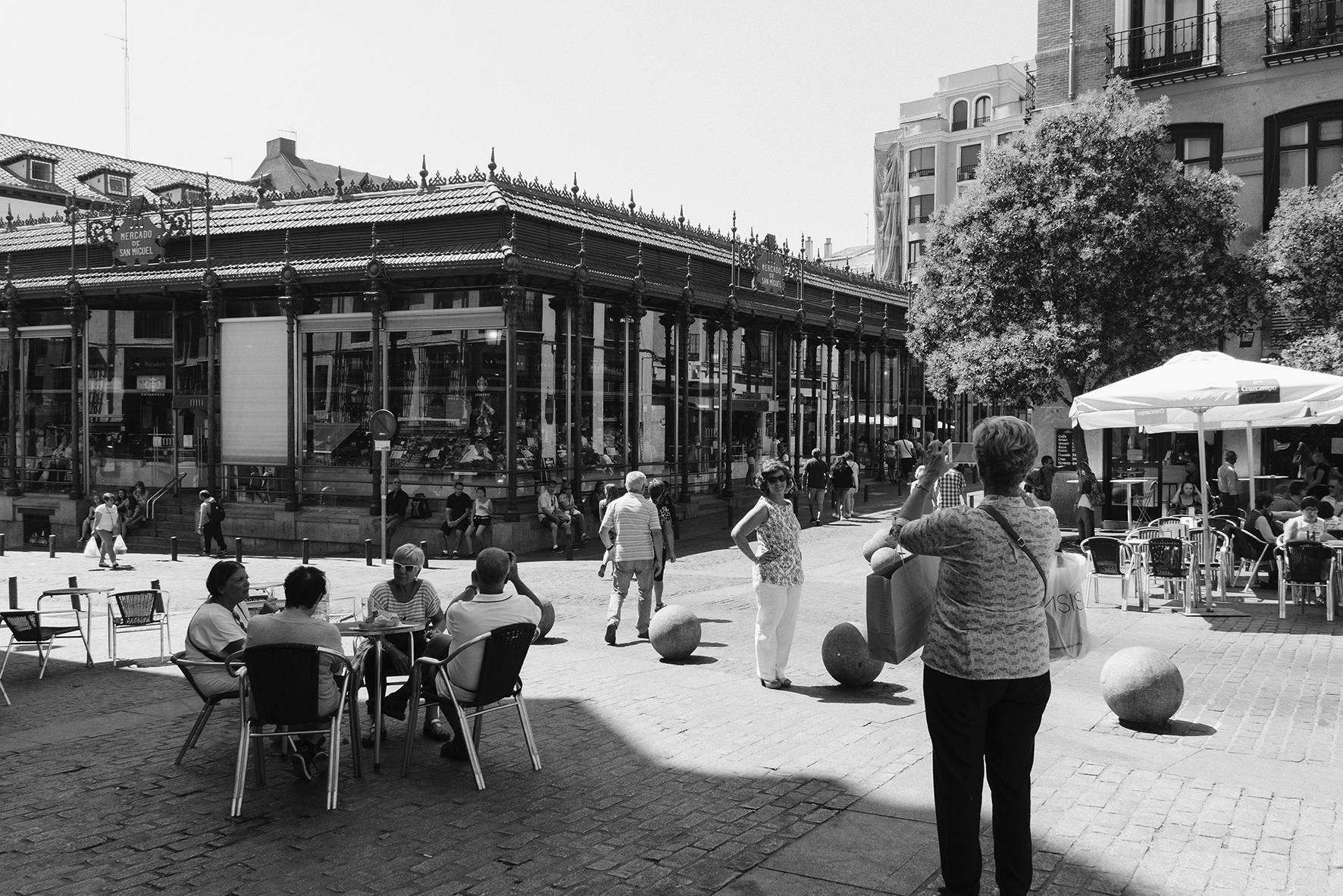
San Miguel Square and Market. Following its designation as a Site of Cultural Interest (BIC) in 2000 and with the help of a public grant, the investment group El Gastrónomo de San Miguel S.L. acquired the former market with the aim of transforming it into a “centre for gastronomic culture.” Following the market’s refurbishment, only two of the thirty-three stalls continued to sell fresh food and other basic necessities. Both were operated by the only traders who refused to terminate their indefinite leases.
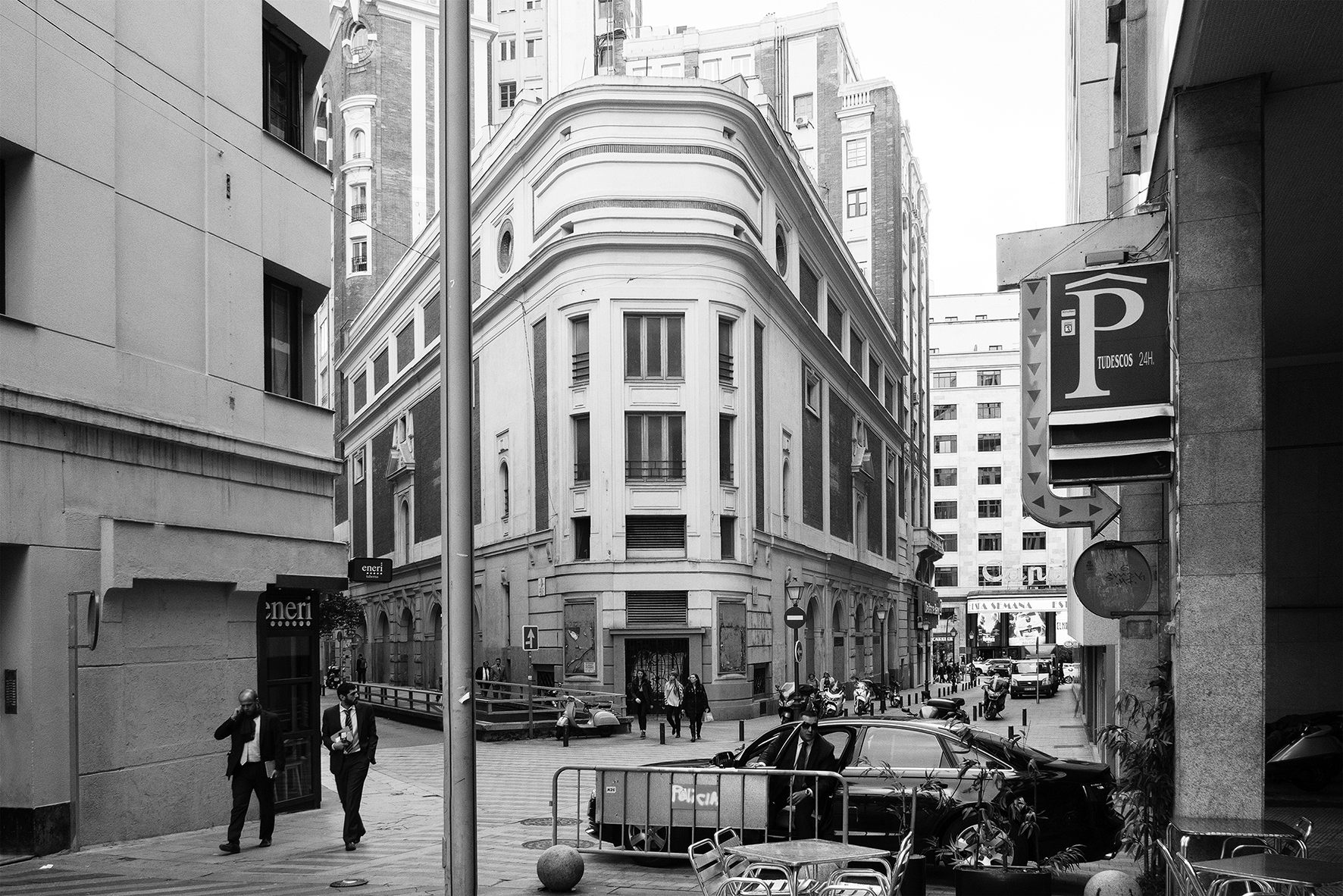
Palacio de la Prensa (Pedro Muguruza, 1924), seen from Calle de Tudescos towards Gran Vía. A refurbishment project for the building has been approved but has yet to be carried out.

Intersection of Calle de Miguel Moya and Calle de Tudescos. Vicinity of Plaza de Santa María Soledad Torres Acosta.

Brothel on Calle de Silva. Sex workers who work on the streets are often the target of police harassment and media sensationalism. Meanwhile, brothel owners profit with impunity by disguising their activities as hotel services. Women working in these establishments may be required to pay up to €100 a day for a room and to adhere to strict working hours imposed by the owner.
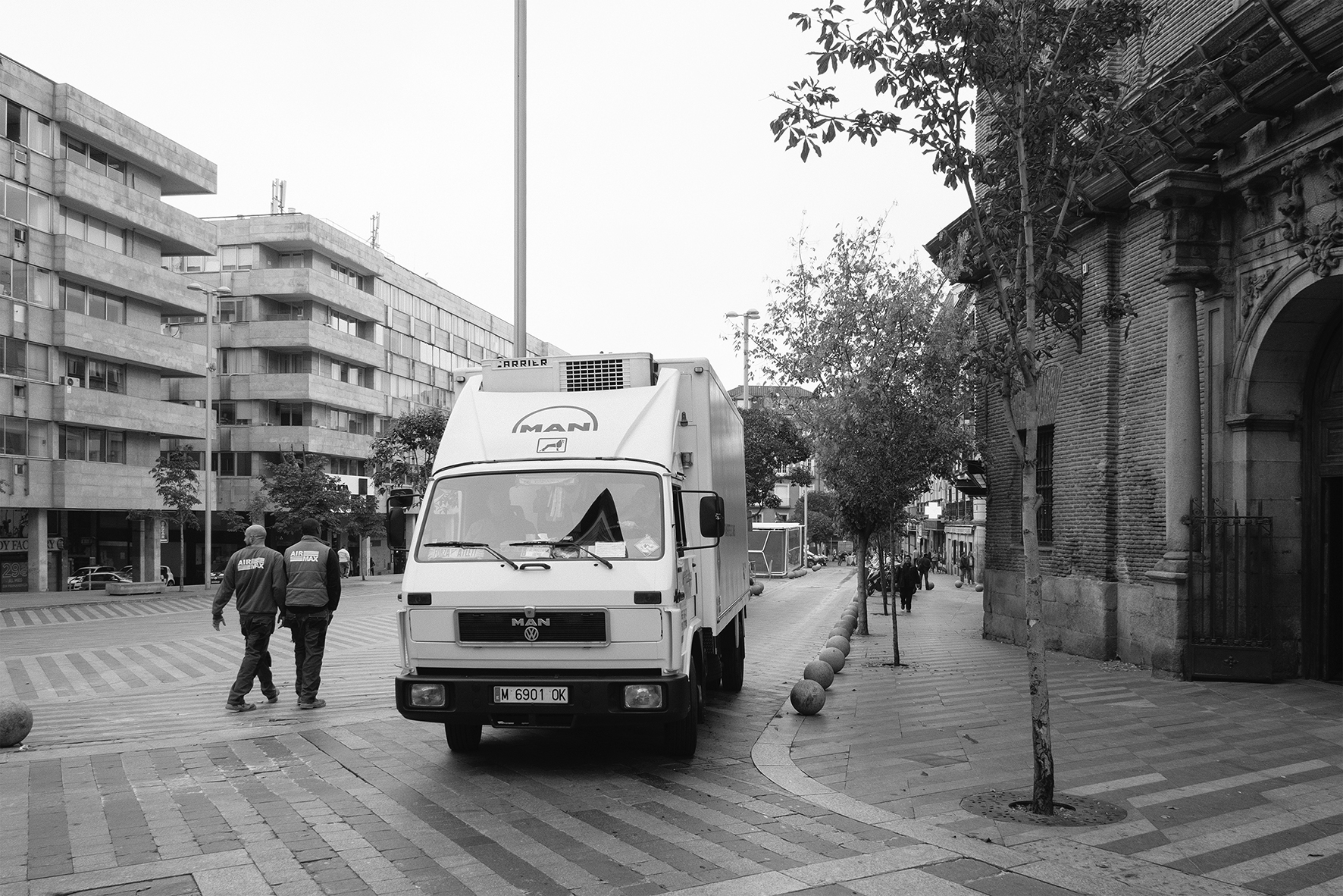 Plaza de Santa Mª Soledad Torres Acosta. Considered a trouble spot, the square was cleared in 2007 at the initiative of the City Council. A police station was opened there and surveillance cameras were installed. The square marks the boundary of the area originally targeted by the TriBall property consortium.

View of Calle del Pez.

Terraces beside the Santa, Pontifical and Royal Brotherhood of the Refuge and Charity of Madrid, at the intersection of Calle de la Ballesta and Calle de la Corredera Baja de San Pablo. Madrid’s oldest soup kitchen, founded in 1615, stands at one of the corners of the area originally targeted by the TriBall property consortium (Triángulo Ballesta), a key force in the regeneration of the Universidad neighbourhood.

Mercado de Fuencarral on Calle de Fuencarral at the intersection with Calle de Augusto Figueroa. Opened in 1998, it became an emblem of Malasaña’s alternative scene during its seventeen years of activity. In 2014, it was acquired by the German investment fund Activum for €22 million. The sale led to the closure of the sixty shops housed in the market. In 2017, the French fund City Retail Fund, managed by AEW Europe, acquired the property for €50 million, more than double its previous purchase price. It now houses a Decathlon sportswear store.

Europa grocery shop on Calle de la Palma.
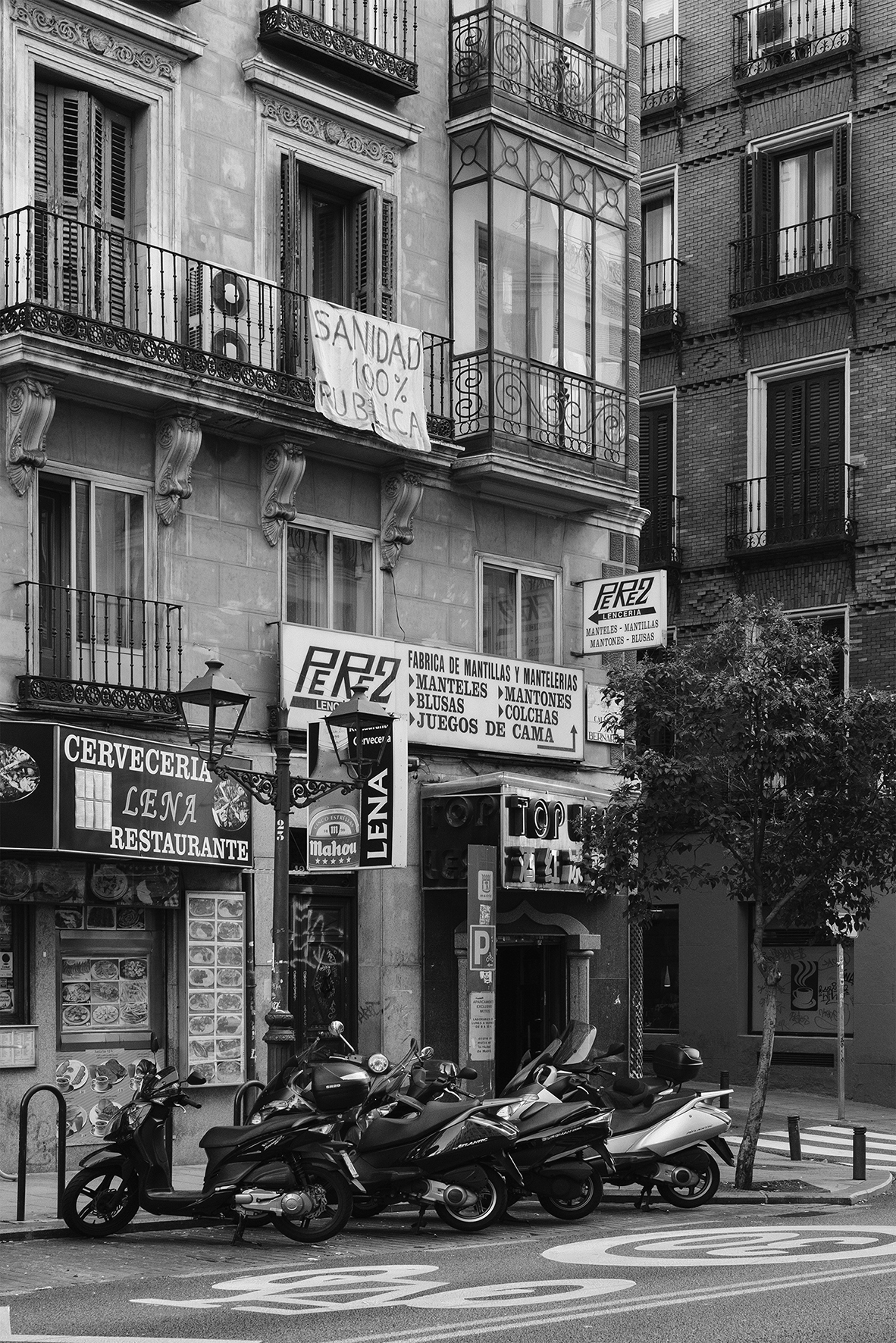
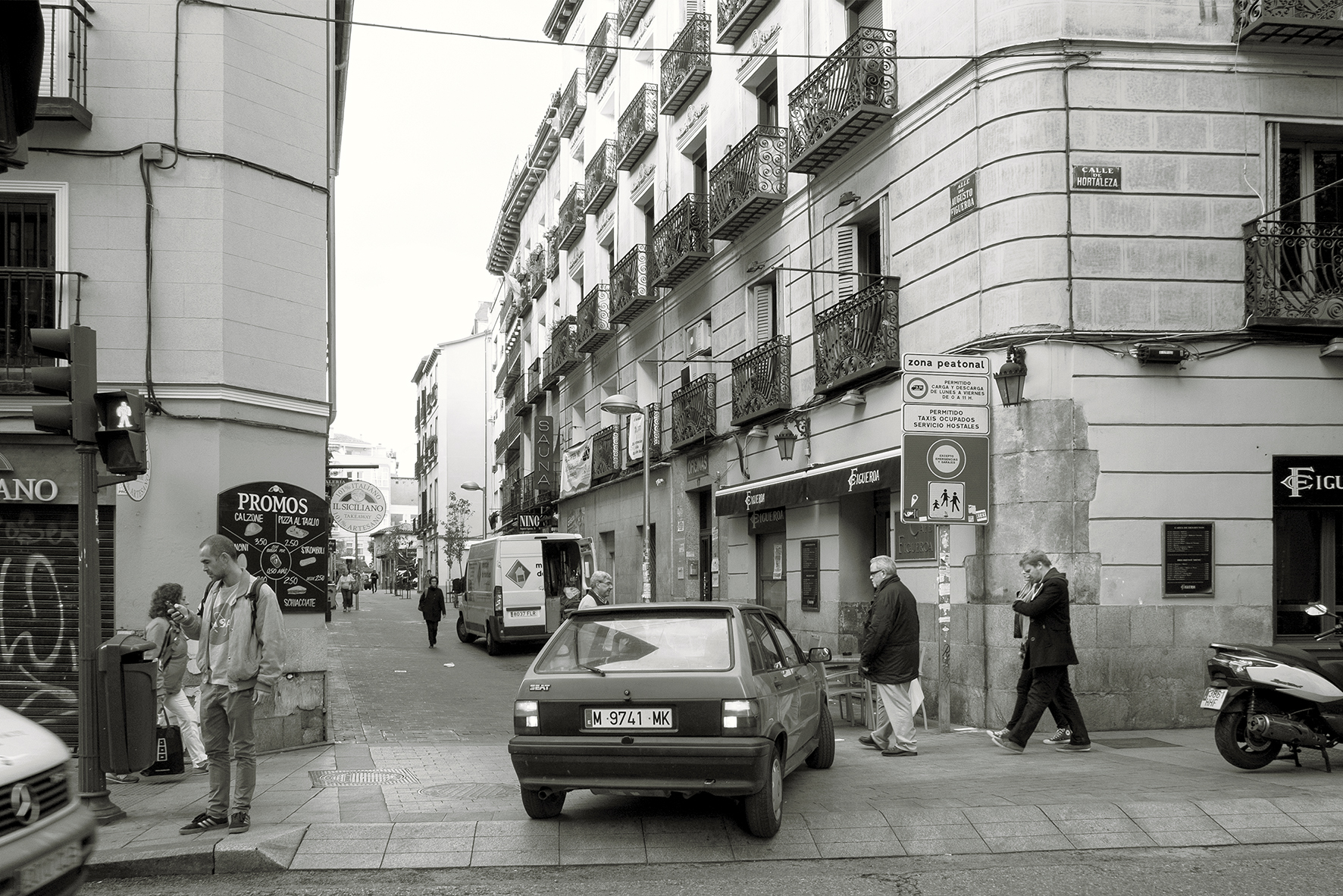
Intersection of Calle de Hortaleza and Calle de Augusto Figueroa.
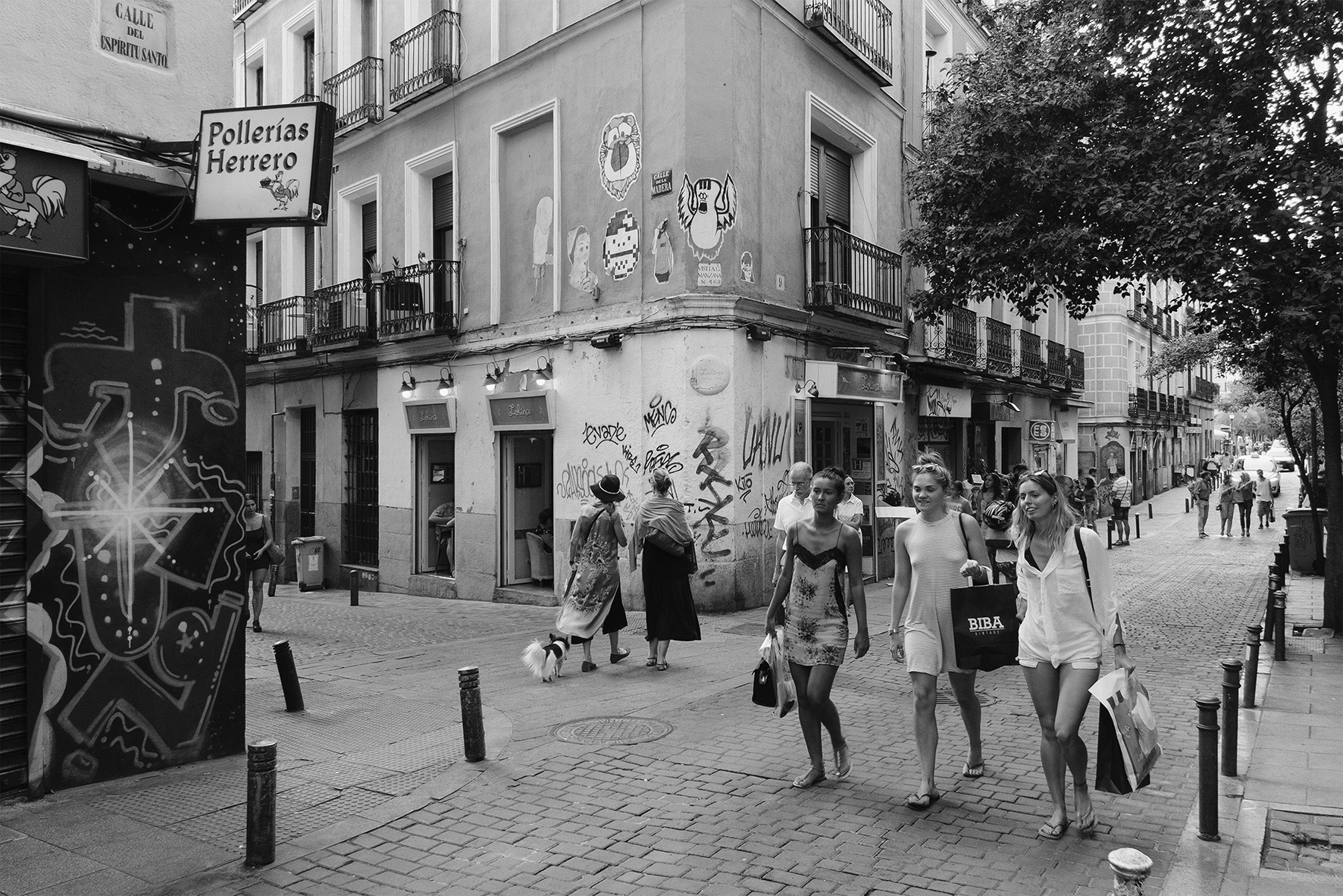
Intersection of Calle de la Madera and Calle del Espíritu Santo. In 2017, at the height of the tourist-apartment boom, Madrid’s Centro district had around 10,000 tourist-use dwellings, according to estimates based on the supply advertised on rental platforms. Between 75% and 80% of these properties were entire homes, with the remainder consisting of rooms. Available estimates pointed to a high degree of non-compliance with the regulations: the supply advertised on platforms far exceeded the number officially registered. Some 58% of advertisers owned multiple properties or rented out more than one dwelling, highlighting the growing weight of large-scale landlords and professional operators in a market that was no longer primarily driven by individuals sharing their primary residence.
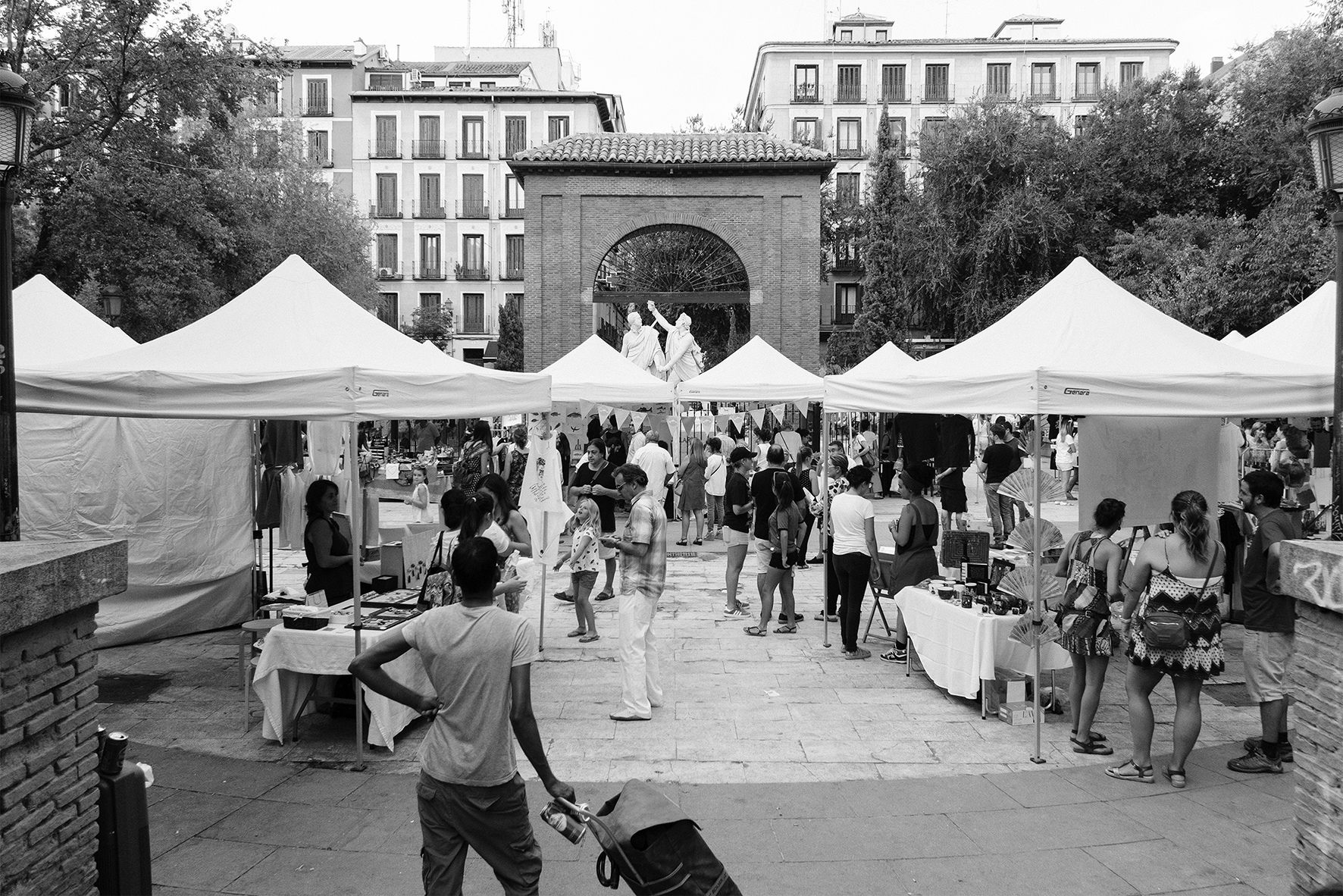
A craft market set up in Plaza del Dos de Mayo.

Patio Maravillas Occupied and Self-Managed Social Centre, at 21 Calle del Pez. The collective’s second premises, an active opponent of municipal policies of gentrification and urban regeneration, was evicted in June 2015. Although Nivel 29, the building’s owner, announced its intention to convert it to tourist accommodation, it has remained vacant and boarded up ever since.

The new Barceló Multi-Purpose Municipal Centre, comprising the Barceló Market and the Mario Vargas Llosa Municipal Library (architects Fuensanta Nieto and Enrique Sobejano), opened in 2013, two years behind schedule and 50% over budget. The project, promoted by the Alberto Ruiz-Gallardón city government, had a final cost of €64 million. In addition, due to deficiencies in the fit-out of the new facilities, traders had to cover unforeseen expenses. This was the only market in the district to be refurbished entirely with public funding. The resources allocated to this project would have been sufficient to refurbish several markets in the area without the need for private investment.

Escuelas Pías de San Antón, now home to the COAM, on Calle de Hortaleza.
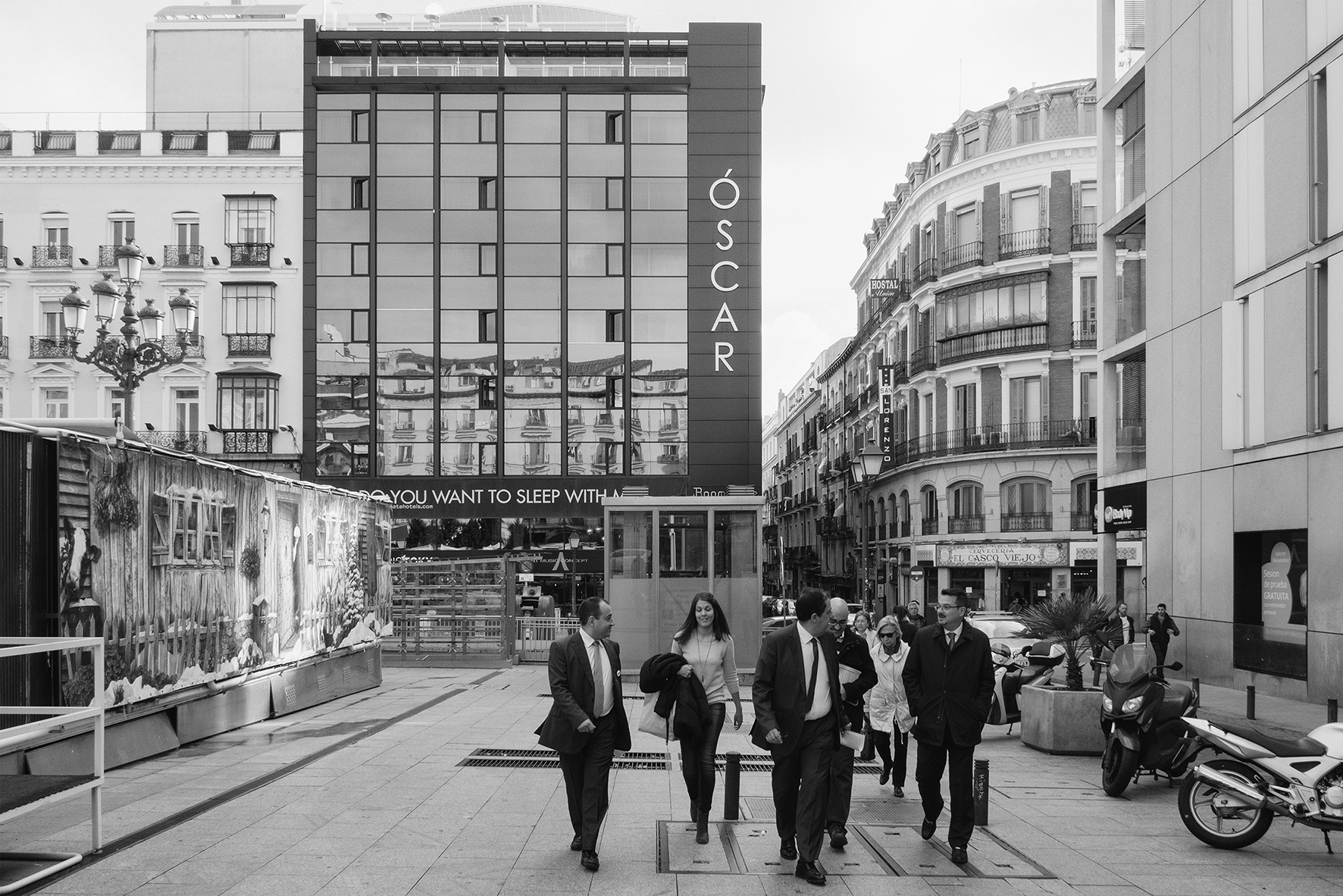
Hotel Óscar, in Plaza de Pedro Zerolo. The hotel chain Room Mate, owned by businessman Enrique Sarasola, was one of the pioneers in integrating tourist accommodation into the hotel offering. In 2014, it created Be Mate, a platform that marketed tourist accommodation offered by private owners and complemented it with hotel-style services. During periods of high demand, the chain began directing its guests to these properties. It currently manages four entire blocks of tourist apartments in the area. It is not the only hotel chain to have adopted this growth model. Sidorme, for example, acquired forty apartments on Calle de Fuencarral and Calle de Montera in 2016. Today, it is estimated that there are around fourteen thousand tourist apartments in central Madrid.

View of Plaza de Chueca. During the 1980s and 1990s, the poor condition of the neighbourhood’s housing stock and the high levels of social unrest drove rents down, facilitating the opening of the first LGBTIQ+ underground venues. The area had been a clandestine meeting place for the community during the dictatorship, so the renewal of Chueca began relatively organically. However, by the early 21st century, urban marketing and the tourism industry had seized upon it, promoting its speculative revaluation and exploiting its queer character as a commercial attraction.

View of Calle de las Infantas.

Medaigual bar on Calle de San Bartolomé.
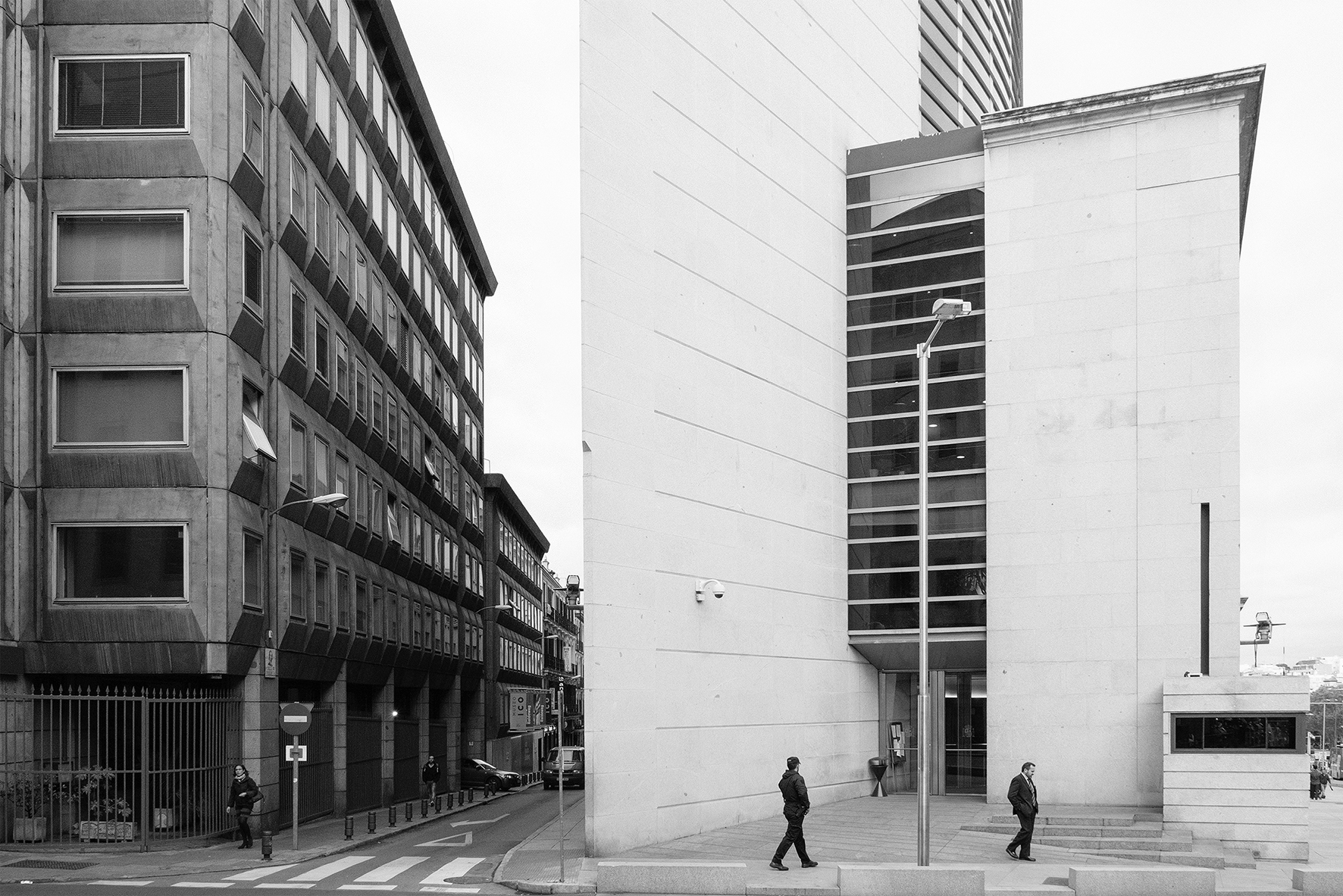
Palacio de las Cortes at the intersection of Calle de Zorrilla and Carrera de San Jerónimo.
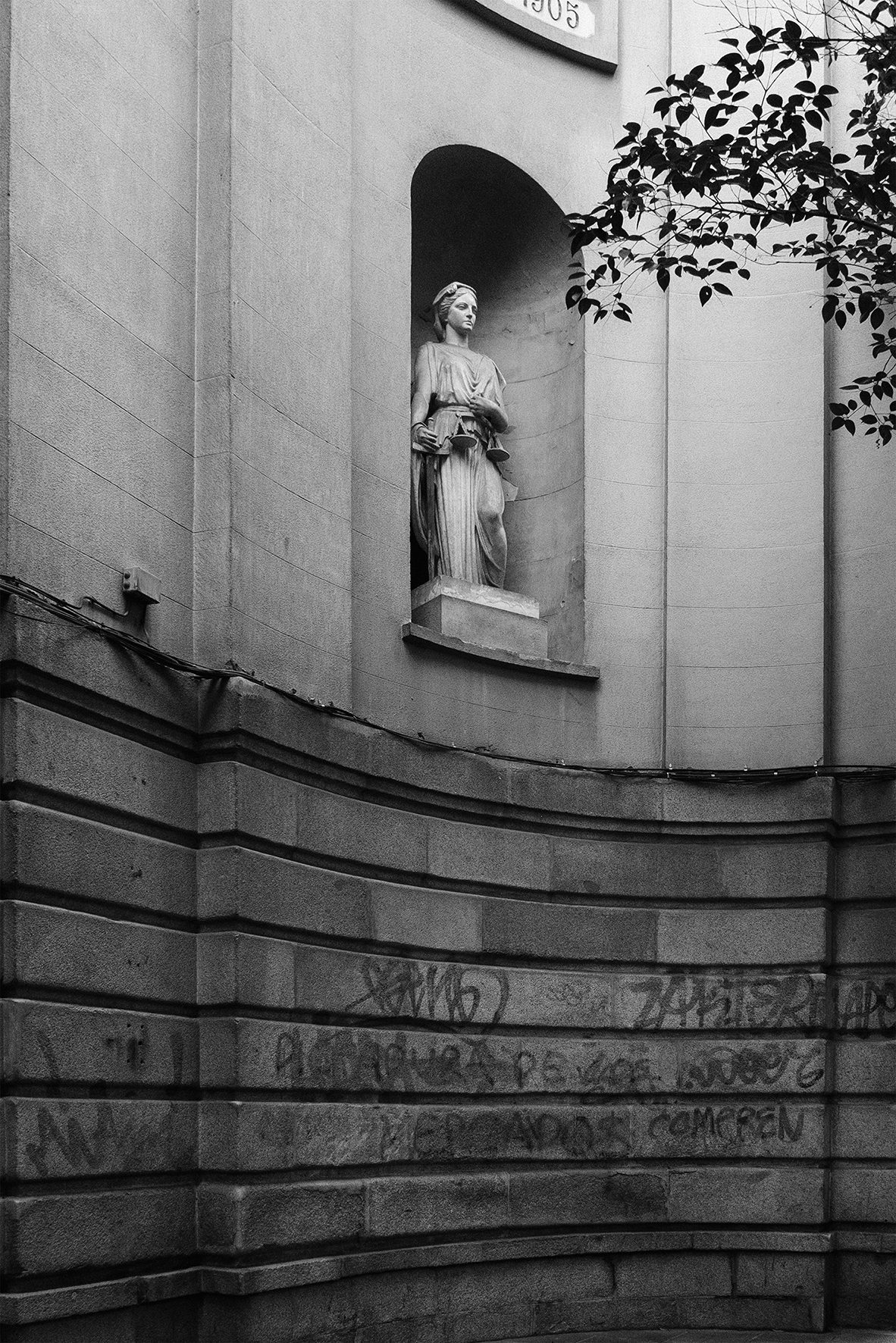
Royal Academy of Jurisprudence and Legislation on Calle del Marqués de Cubas. Days after the demonstration against the “Gag Law” (Citizen Security Law) on 24 January 2015, a partially erased piece of graffiti could still be seen beneath the allegory of Justice: “Dictatorship of the Markets.”
A PLACE WITH NO SHELTER, 2014-16
Series of 50 black and white photographs
Archival pigment prints on baryta paper
Image: 22.5 x 15 cm / Frame: 27.5 x 20 cm
Edition of 5 + 2 AP
Series of 50 black and white photographs
Archival pigment prints on baryta paper
Image: 22.5 x 15 cm / Frame: 27.5 x 20 cm
Edition of 5 + 2 AP